
Context
These projects were part of my Licence Computer Science coursework at UPEC. The objective: implement classic games from scratch to develop mastery of Object-Oriented design, data structures, and classical AI algorithms.
No game engines. No frameworks. Pure Java with javax.swing for rendering.
Pac-Man — Ghost AI with BFS
Architecture
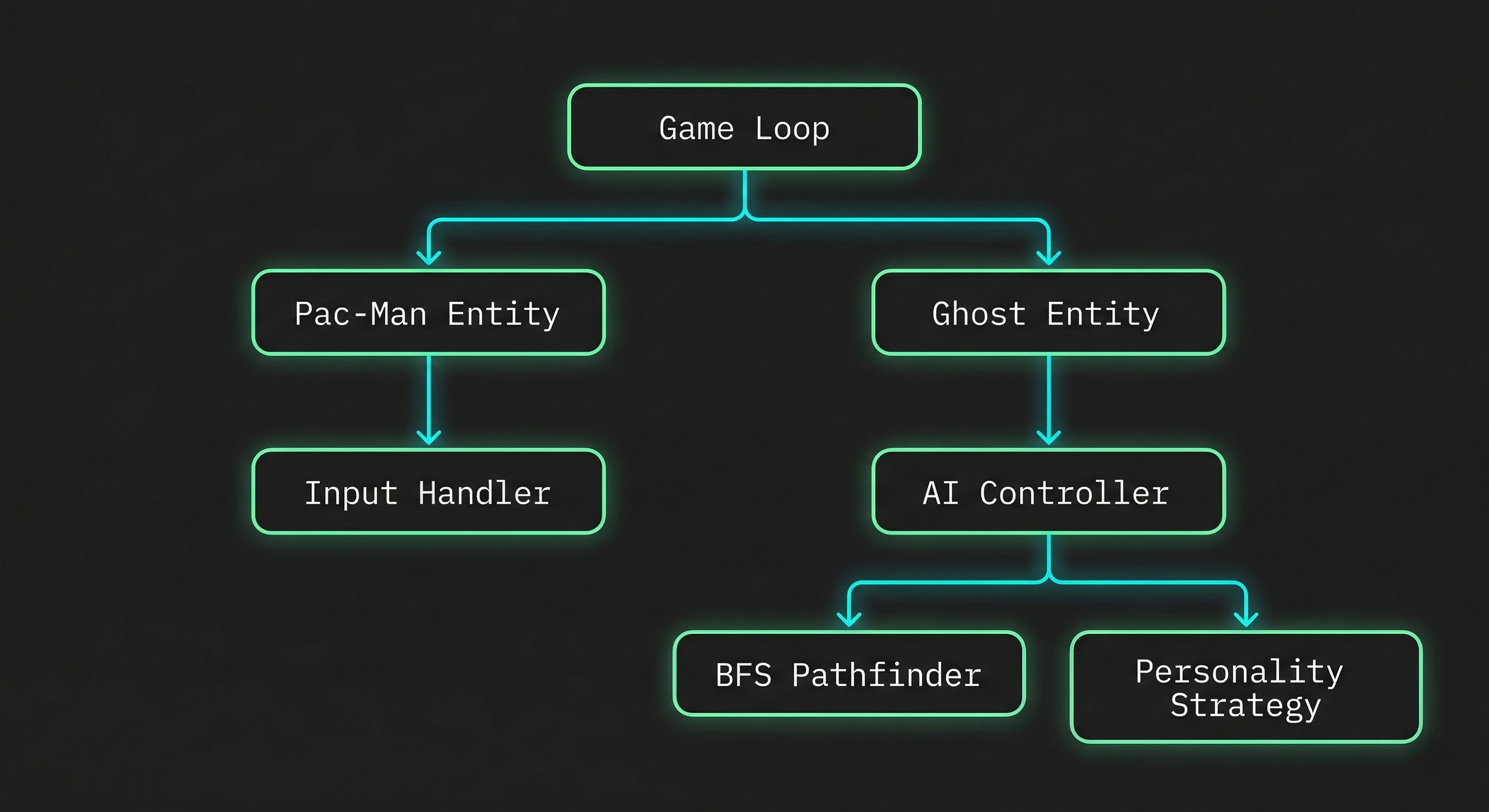
BFS Pathfinding
Each ghost runs BFS on the maze graph to find the shortest path to its current target:
// pathfinding/BFSPathfinder.java
public class BFSPathfinder {
    private final boolean[][] walls;
    private final int rows, cols;

    private static final int[][] DIRECTIONS = {{-1,0},{1,0},{0,-1},{0,1}};

    public List<Point> findPath(Point start, Point target) {
        if (walls[target.y][target.x]) return Collections.emptyList();

        Queue<Point> queue = new LinkedList<>();
        Map<Point, Point> parent = new HashMap<>();

        queue.offer(start);
        parent.put(start, null);

        while (!queue.isEmpty()) {
            Point current = queue.poll();

            if (current.equals(target)) {
                return reconstructPath(parent, target);
            }

            for (int[] dir : DIRECTIONS) {
                Point neighbor = new Point(
                    current.x + dir[1],
                    current.y + dir[0]
                );

                if (isValid(neighbor) && !parent.containsKey(neighbor)) {
                    parent.put(neighbor, current);
                    queue.offer(neighbor);
                }
            }
        }

        return Collections.emptyList(); // No path found (should not happen in Pac-Man)
    }

    private boolean isValid(Point p) {
        return p.x >= 0 && p.x < cols
            && p.y >= 0 && p.y < rows
            && !walls[p.y][p.x];
    }

    private List<Point> reconstructPath(Map<Point, Point> parent, Point target) {
        List<Point> path = new ArrayList<>();
        Point current = target;
        while (current != null) {
            path.add(0, current);
            current = parent.get(current);
        }
        return path;
    }
}
Ghost Personalities — Strategy Pattern
The four Pac-Man ghosts have different targeting strategies — a great application of the Strategy pattern:
// ghost/strategy/GhostStrategy.java
public interface GhostStrategy {
    Point getTarget(Ghost ghost, PacmanEntity pacman, Ghost[] allGhosts, Maze maze);
}

// Blinky: targets Pac-Man's exact position (direct chaser)
public class BlinkyStrategy implements GhostStrategy {
    @Override
    public Point getTarget(Ghost ghost, PacmanEntity pacman,
                           Ghost[] allGhosts, Maze maze) {
        return pacman.getGridPosition();
    }
}

// Pinky: targets 4 tiles ahead of Pac-Man (ambusher)
public class PinkyStrategy implements GhostStrategy {
    @Override
    public Point getTarget(Ghost ghost, PacmanEntity pacman,
                           Ghost[] allGhosts, Maze maze) {
        Point pac = pacman.getGridPosition();
        Direction dir = pacman.getDirection();
        return new Point(
            pac.x + dir.dx * 4,
            pac.y + dir.dy * 4
        );
    }
}

// Clyde: targets Pac-Man when far, scatters when close (shy)
public class ClydeStrategy implements GhostStrategy {
    private static final int SCATTER_THRESHOLD = 8; // tiles

    @Override
    public Point getTarget(Ghost ghost, PacmanEntity pacman,
                           Ghost[] allGhosts, Maze maze) {
        double distance = ghost.getGridPosition().distance(pacman.getGridPosition());
        if (distance > SCATTER_THRESHOLD) {
            return pacman.getGridPosition(); // Chase
        }
        return maze.getClydeScatterCorner(); // Scatter to bottom-left
    }
}
Othello — Minimax with Alpha-Beta Pruning
Othello (Reversi) is a perfect-information 2-player game, ideal for the minimax algorithm. Without optimizations, the game tree has ~58! nodes. Alpha-beta pruning reduces effective branching factor from ~10 to ~3-4.
// ai/MinimaxEngine.java
public class MinimaxEngine {
    private final OthelloBoard board;
    private final int maxDepth;
    private final Heuristic heuristic;

    // Returns best move for current player
    public Move getBestMove(BoardState state, Disc player) {
        Move best = null;
        int bestScore = Integer.MIN_VALUE;

        for (Move move : state.getLegalMoves(player)) {
            BoardState next = state.apply(move);
            int score = minimax(next, maxDepth - 1, Integer.MIN_VALUE,
                                Integer.MAX_VALUE, false, player);
            if (score > bestScore) {
                bestScore = score;
                best = move;
            }
        }
        return best;
    }

    private int minimax(BoardState state, int depth, int alpha, int beta,
                        boolean maximizing, Disc originalPlayer) {
        // Base case: terminal state or max depth
        if (depth == 0 || state.isTerminal()) {
            return heuristic.evaluate(state, originalPlayer);
        }

        Disc currentPlayer = maximizing ? originalPlayer : originalPlayer.opponent();
        List<Move> moves = state.getLegalMoves(currentPlayer);

        // No legal moves: pass turn (Othello rule)
        if (moves.isEmpty()) {
            return minimax(state, depth - 1, alpha, beta, !maximizing, originalPlayer);
        }

        if (maximizing) {
            int value = Integer.MIN_VALUE;
            for (Move move : moves) {
                value = Math.max(value,
                    minimax(state.apply(move), depth - 1, alpha, beta, false, originalPlayer));
                alpha = Math.max(alpha, value);
                if (beta <= alpha) break; // Beta cut-off (prune)
            }
            return value;
        } else {
            int value = Integer.MAX_VALUE;
            for (Move move : moves) {
                value = Math.min(value,
                    minimax(state.apply(move), depth - 1, alpha, beta, true, originalPlayer));
                beta = Math.min(beta, value);
                if (beta <= alpha) break; // Alpha cut-off (prune)
            }
            return value;
        }
    }
}
Othello Heuristic
The heuristic is not just coin count — that’s a common mistake for beginners. Corner control and mobility matter far more:
// ai/OthelloHeuristic.java
public class OthelloHeuristic implements Heuristic {
    // Positional weight matrix (8x8 board)
    private static final int[][] WEIGHTS = {
        {120,-20, 20,  5,  5, 20,-20,120},
        {-20,-40, -5, -5, -5, -5,-40,-20},
        { 20, -5, 15,  3,  3, 15, -5, 20},
        {  5, -5,  3,  3,  3,  3, -5,  5},
        {  5, -5,  3,  3,  3,  3, -5,  5},
        { 20, -5, 15,  3,  3, 15, -5, 20},
        {-20,-40, -5, -5, -5, -5,-40,-20},
        {120,-20, 20,  5,  5, 20,-20,120}
    };

    @Override
    public int evaluate(BoardState state, Disc player) {
        int score = 0;

        // 1. Positional score (corners = 120, edges = negative)
        for (int r = 0; r < 8; r++) {
            for (int c = 0; c < 8; c++) {
                if (state.get(r, c) == player)       score += WEIGHTS[r][c];
                else if (state.get(r, c) == player.opponent()) score -= WEIGHTS[r][c];
            }
        }

        // 2. Mobility: more legal moves = more flexibility
        int myMoves  = state.getLegalMoves(player).size();
        int oppMoves = state.getLegalMoves(player.opponent()).size();
        if (myMoves + oppMoves > 0)
            score += 10 * (myMoves - oppMoves) / (myMoves + oppMoves);

        return score;
    }
}
Key Takeaways
- BFS vs. A*: BFS guarantees shortest path in unweighted graphs. For Pac-Man’s maze (uniform costs), BFS is optimal — A* would only help if moves had different costs.
- Alpha-beta pruning can reduce minimax from O(b^d) to O(b^(d/2)) with perfect move ordering — doubling the effective search depth for the same compute budget.
- Strategy pattern isn’t abstract theory — Pac-Man’s four ghosts are a textbook case where polymorphism makes the codebase readable and extensible.